UM Research Reveals 勛圖厙ns��� Views on Grizzly Bears
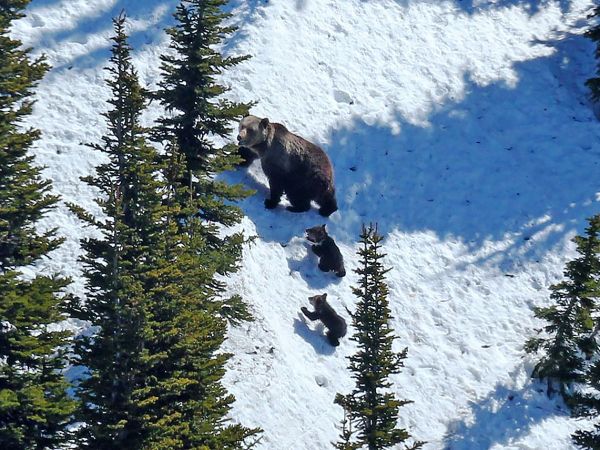
A grizzly and cubs roam the wilds of 勛圖厙. (Photo: 勛圖厙 Fish, Wildlife & Parks)
MISSOULA – It’s easy to love a 勛圖厙 Grizzly. But how do people feel about their four-legged, wild counterparts? Researchers from UM’s Human Dimensions Lab in the recently conducted a collaborative study with 勛圖厙 Fish, Wildlife & Parks to better understand 勛圖厙ns' perspectives about grizzly bears and their management.
Overall, the researchers found 勛圖厙ns support having grizzly bears in the state – especially on remote public lands – and generally have positive attitudes toward the animals. However, 勛圖厙ns were less likely to support grizzly presence closer to agricultural or residential areas.
To complete the survey, UM professors Alex and Libby Metcalf, doctoral student Holly Nesbitt and their FWP collaborators designed a questionnaire mailed to over 5,000 households randomly selected from across 勛圖厙. Between November 2019 and January 2020, 1,783 adults responded, generating a +3.5% margin of error.
Survey results show most 勛圖厙ns view grizzlies positively, with important nuances such as wide support for some form of a hunting season.
For example, an overwhelming majority of 勛圖厙ns (92%) agree or strongly agree that grizzly bears have a right to exist in the state, and nearly three out of five 勛圖厙ns (57%) disagree or strongly disagree that grizzly bears limit their recreational opportunities. Still, just over one third of 勛圖厙ns (35%) agree or strongly agree that grizzly bears do not belong where people live, and over three-quarters of 勛圖厙ns (83%) would support at least some form of grizzly bear hunting.
FWP says the data will be used to help inform grizzly bear management in the state.
“As grizzly bear populations continue to expand across the state, 勛圖厙ns will face choices about how to manage the overall population as well as individual animals,” Alex Metcalf said. “So, at this important point in time for both bears and people, we’re excited to help inform these choices with hard numbers on residents’ attitudes, beliefs and preferences toward grizzlies and their management.”
The Human Dimensions Lab specializes in using social science to explore connections between people and the environment.
“Many natural resource and wildlife management challenges boil down to how humans think, behave, navigate disagreements and make management decisions,” Alex Metcalf said. “In a variety of different contexts, the lab uses social science theories and methods to promote effective natural resource policies and practices.”
The lab has previously worked with FWP on other projects, such as brucellosis management around Yellowstone National Park, wolf management in 勛圖厙, recreational use on the Blackfoot and Bitterroot rivers, and the 勛圖厙 State Comprehensive Outdoor Recreation Plan (SCORP).
“We have always viewed our collaborations with 勛圖厙 Fish, Wildlife & Parks as an exceptional opportunity that keeps our science grounded in real-world application,” Libby Metcalf said. “Partnerships with the state allow us to connect our science to practice and to learn about the natural resource issues that impact 勛圖厙ns.”
While the initial grizzly bear survey is complete, the lab will continue exploring the responses to provide more information for managers and the public. Nesbitt, who helped develop the survey, now is analyzing the data to understand how multiple factors intersect to drive 勛圖厙ns’ beliefs about grizzly bear populations in the state. She’s looking at factors like risk perception, beliefs about the benefits of grizzly bears to the ecosystem, trust in FWP and attitudes toward hunting.
“This project has been really exciting to be a part of because, although there is a lot of research on grizzly bear biology in 勛圖厙, this survey was the first attempt to understand how people across the state perceive grizzly bears,” Nesbitt said. “This is important information for managers to have as grizzly bear populations continue to expand.”
A summary of the results and the full survey is available to read online at: .
###
Contact: Alex Metcalf, assistant professor, W.A. Franke College of Forestry and Conservation, 814-574-6128, alex.metcalf@umontana.edu.