SUBSEA Expedition
CREDIT: Bernarda Cornejo Pinto / Schmidt Ocean Institute
Oceanographers from 勛圖厙’s Flathead Lake Biological Station recently set out with their students to study the South Atlantic subtropical ocean gyre, one of five massive wind-driven currents that regulate global temperatures and sustain life across the open ocean. Over 35 days at sea, they studied how nutrients and carbon move through the upper ocean and support life in some of Earth's most remote marine environments.
Meet UM's SUBSEA Team
The 勛圖厙 contingent of SUBSEA (Subtropical Underwater Biogeochemistry and Subsurface Export Alliance) includes two faculty from the University of 勛圖厙's Flathead Lake Biological Station (FLBS), Dr. Matt Church and Dr. Bob Hall; two postdoctoral researchers, Dr. Esther Mak and Dr. Deepika Sahoo; and two recent UM graduates, master's student Jared McGourty and research technician Katie Coates.
Only two team members are formally trained oceanographers, and the others bring knowledge and expertise in microbiology, stream ecology, and wildlife biology. For most of the team, this was their first oceanographic research cruise.
An aquatic microbial ecologist, SUBSEA project lead Dr. Church spent several years at the University of Hawai’i in the Department of Oceanography where he led projects studying microscopic life in water environments. His research focused on identifying the microbes responsible for biogeochemical processes—cycles of elements between life, land, water, and air— to understand how these tiny organisms take up elements, metabolize, and transform them.
It may seem strange for an oceanographer to be based in 勛圖厙, but FLBS created new opportunities to extend Dr. Church’s research into freshwater systems. The ocean is far removed, but many of the same processes that shape the ocean also operate in freshwater environments. At FLBS, Dr. Church has been able to apply his research on microbial processes in low-nutrient environments to Flathead Lake, while building a collaborative team of scientists with shared interests in aquatic science.

Studying Earth's Largest Ecosystems
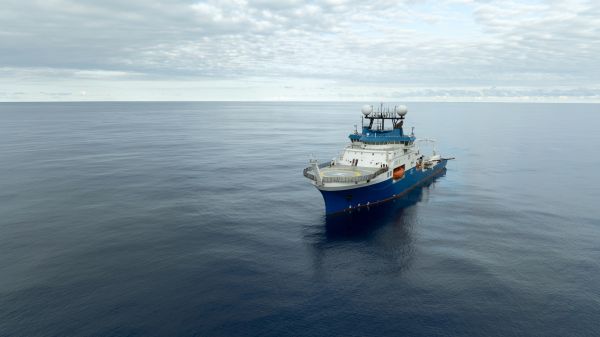
Subtropical ocean gyres are among the largest ecosystems on Earth, spanning more than 20% of the Earth’s surface, yet they remain understudied because they are difficult to access. The SUBSEA project collected data on biogeochemical processes occurring below the surface of the South Atlantic subtropical ocean gyre during a 35-day expedition off the coast of Brazil on the research vessel Falkor(too).
Biogeochemical processes keep Earth’s systems working by recycling the elements organisms need to grow and survive. These processes also regulate the carbon cycle which helps control how much carbon dioxide is in the atmosphere, influencing global climate. Subtropical ocean gyres contribute to these cycles by affecting how nutrients and carbon move through marine ecosystems.
Phytoplankton grow near the surface of the ocean, converting carbon dioxide into organic material. When those cells die, they begin to sink, and as they descend, they are continuously decomposed by microbes. This process releases nutrients that may be reused by organisms deeper in the upper ocean, creating a connection between surface production and subsurface ecosystems.
Despite low concentrations of nutrients and limited capacity to support phytoplankton—the foundation of the marine-life food web—subtropical gyres are important components of the global carbon cycle and can be studied from anywhere using remote technologies such as satellites, but those tools only capture conditions at the surface.
Much of the biology that drives these systems is a mystery, occurring deeper in the water column, where plankton grow and nutrients are recycled out of view. Studying those processes requires going to sea, which is challenging given the vast size of these regions.
In March and April 2026, SUBSEA occupied a series of stations across the South Atlantic to study these ecosystems.

How they do it
SUBSEA voyaged to South Atlantic stations on the Falkor(too). At one station, they studied waters with very low phosphate concentrations, which are typical of nutrient-poor environments. At another, they observed a phytoplankton bloom that was dying off.
Although the surface waters appeared clear and blue, measurements showed high amounts of organic matter below the surface and more particles sinking downward. This gave the team an opportunity to see how organic material is broken down and recycled.
The differences between these stations are reflected in the structure of the water column, an imaginary pillar of water that stretches from the ocean floor to the surface. A column is a way of thinking about a slice of the ocean that researchers study from bottom to top.
In some places, the chlorophyll maximum—the area below the water’s surface with the highest concentration of chlorophyll—occurs more than 100 meters deep. In other areas it is much shallower. In the most nutrient-poor waters, the team has observed an exceptionally deep photic zone.
The photic zone is the dimly lit part of the ocean where light still affects biological processes. It’s the area where phytoplankton photosynthesize. Its exceptional depth in these areas supports biological activity and extends the distance over which sinking material can be transported and transformed.
To capture these dynamics, the team combined ship-based sampling with autonomous instruments.
- Seawater is collected using a Conductivity, Temperature, and Depth (CTD) rosette, an instrument used to measure the physical, chemical, and biological properties of the ocean. The CTD allows researchers to sample water from specific depths throughout the water column.
- Sediment traps collect sinking particles at multiple depths, allowing researchers to measure the movement of carbon, nitrogen and other elements through the water column.
- A Wirewalker profiler, a wave-powered profiling system used to collect data on water columns, repeatedly samples the upper ocean, collecting high-resolution measurements of temperature, oxygen and chlorophyll.
- A Seaglider, a high-speed electric maritime vessel, provides additional spatial context by mapping conditions around the ship.
The team designed experiments to measure nutrient cycling, primary production, and microbial activity, studying how energy and nutrients flow through an ecosystem and how microbes regulate those processes.
They used net tows to sample zooplankton and acoustic observations that track their daily vertical migrations in the water column. Each evening, organisms move hundreds of meters toward the surface before returning to depth before sunrise, contributing to the transport of carbon through the ocean.
Sampling continued day and night, with scientists rotating through shifts to maintain continuous operations. Over the course of the expedition, the team conducted 80 CTD casts and carried out various experiments to examine how nutrients are recycled and reused within the upper ocean.
Together, these observations will help clarify how microscopic processes scale up to influence entire ocean ecosystems. By linking the production of organic material at the surface to its transformation and reuse by organisms in deep water, the SUBSEA team is working to better understand how these vast regions of the ocean store carbon and respond to environmental change.
Analyzing the Samples

CREDIT: Bernarda Cornejo Pinto / Schmidt Ocean Institute
While the SUBSEA expedition provided a rare opportunity to study the open ocean directly, the research does not end when the ship returns to port.
The same ecological processes that shape ocean systems, including particle sinking, microbial decomposition, and nutrient recycling can be studied in lakes and rivers close to home. This creates opportunities for students to engage in research that connects the study of these mechanisms—locally—to a global scale.
Analysis of cruise samples will begin alongside ongoing freshwater research. Many of the same questions explored at sea can be investigated in freshwater systems, where access is easier and long-term study is possible. Samples collected during the cruise will be processed in labs at each of the collaborators’ home institutions.

At FLBS, researchers will measure nutrient concentrations, examine microbial communities, and quantify rates of biological activity. Analyzing these data will help clarify how nutrients are recycled and how carbon is exported from the surface of the water to be stored on the ocean floor. This will fill critical gaps in knowledge about subtropical gyres, shedding light on how the ocean regulates Earth’s climate and sustains marine life.
Looking ahead, the SUBSEA team is already preparing for future work, including a planned return to the region in 2027. The data collected during this expedition will contribute to a growing effort to better understand how the ocean responds to environmental change.
By improving knowledge of how carbon and nutrients move through subtropical gyres, the research will help inform models that predict how these vast ecosystems influence the global climate system.
���The ocean needs all of us!���

The transition back to life on land marks the end of an intense and immersive chapter. After 35 days at sea, the experience left a lasting impression, not only in the data collected, but in the shared effort behind it. The expedition brought together a group of scientists, technicians and crew who worked continuously to make the research possible, building both scientific understanding and a strong sense of collaboration.
The successful study of subtropical ocean gyres depends on a wide range of skills and perspectives. The team on the research vessel included not only scientists, but also marine technicians, engineers, artists, and storytellers.
Broad participation in these research opportunities is possible due, in large part, to advances in technology that have expanded where ocean science can be done. In the past, oceanography was largely limited to coastal institutions, but today scientists can study the ocean from anywhere.
Satellite observations, autonomous instruments and publicly available datasets allow researchers to track large-scale ocean processes, while open proposal calls from organizations like Schmidt Ocean Institute have made access to research vessels more widely available to people from a range of disciplines.
The expedition aboard the research vessel Falkor(too) focused on a part of the ocean that satellites cannot easily observe. While surface waters in subtropical ocean gyres are well studied, much less is known about the deeper layers of the sunlit ocean, where nutrients are more available and biological activity continues out of view.
For many members of the research team, the most memorable moments were not only scientific discoveries, but the experience of working continuously in a place so far removed from everyday life.
Life aboard the vessel required adapting to a continuous schedule of sampling, with work taking place at all hours of the day and night. Through this work, the team learned not only about the ocean, but also about collaboration, building trust, and relying on each other to meet the demands of life at sea.
By combining ship-based sampling with advanced instruments and teamwork, SUBSEA aims to better understand how carbon and nutrients move between the surface and depth, and how those processes support life in the open ocean.
FLBS is grateful for the entire at-sea team, as well as for the support provided by Schmidt Sciences that made this work possible. From the open waters of the South Atlantic back to the lakes of northwest 勛圖厙, this project shows that ocean science is no longer limited by geography. The work continues!
Student Reflections
Jared

I first learned about the Flathead Lake Biological Station (FLBS) from my professor, Matt Church. He described it as a fun way to get credits and obtain meaningful field work experience. But I didn’t know how impactful that one summer at the station would be. Before I took classes at the station, I didn’t realize that microbiology and fieldwork could be one and the same.
I graduated from the UM with a B.S. in microbiology and completed an internship at the NIH's Rocky Mountain Laboratory (RML), where I studied Salmonella. I’m grateful for everything I learned at RML, but the most important thing I learned is how much working in the field matters to me.
I couldn’t stop thinking about my experiences at FLBS, so I reached out to Matt and asked for a job. After some back and forth, I found myself packing and getting ready to move to Polson to start my new position as a Church lab technician.
After a month or so of extracting DNA and quantifying different microbes from ocean samples, Matt broke the news to me. We were on a station-wide river float trip when he told me I would get to embark on the ultimate form of field work: a five-week-long research cruise out of Brazil.
I’d only ever seen the ocean four times, and now I was heading to the South Atlantic to join the SUBSEA project. At that moment, all I felt was pure excitement for the opportunity— followed by a little anxiety.
Living at sea for five weeks seemed like a bit of a jump. As the cruise crept closer and closer, I began to feel more and more excitement about the research that I would be a part of. It was beyond belief that I, a UM microbiology graduate, would get to study how microbes support algal growth in some of the most nutrient-poor regions on earth. I never would have guessed that this was where I would end up, and I wouldn’t trade it for anything.
During the cruise, I was amazed by the people I found myself surrounded by and how much I was able to learn in such a short period. As someone who was thrown into oceanography by chance, the advice I have for my fellow students at the 勛圖厙 is that science—like oceanography—are open to everyone. You don’t even have to see the ocean to study it. If you find there is something you want to study, there are opportunities out there.
I am truly grateful to the 勛圖厙 and SUBSEA for supporting my research goals and providing me with such great experiences.
Katie

When I started college at the 勛圖厙, I did not have a clear plan for where I was headed. I chose to study wildlife biology because I knew I loved the natural world, but I didn’t know what questions I wanted to ask or what kind of scientist I wanted to become.
A summer internship at the Flathead Lake Biological Station sparked my interest in aquatic science and encouraged me to pursue my long-standing curiosity about marine ecosystems. Building on that experience, I completed a senior thesis focused on zooplankton with my professor, Matt Church, in collaboration with researchers at Oregon State University.
My study explored how zooplankton are impacted by climate change. Through this work, my focus expanded to consider how zooplankton, and eventually microbes, influence biogeochemical cycles and help regulate climate. After graduating in May 2025 from the Davidson Honors College with a B.S. in Wildlife Biology, I joined Dr. Church’s lab as a research technician and became involved in the SUBSEA project.
My current work is a departure from wildlife biology, but it reflects the strength and flexibility of my undergraduate training. After studying in a landlocked state, I assumed that entering a field like oceanography required a much more specialized background. Instead, the skills I gained at the 勛圖厙 translated directly into the work I wanted to do.
My coursework provided a broad foundation in biology, ecology, and research methods that applies directly to oceanographic science. Just as importantly, the support I received at the 勛圖厙 made these opportunities possible. Through the Davidson Honors College, I gained guidance on applying to research internships, and university scholarships provided the financial support that allowed me to pursue research experiences that ultimately shaped my trajectory.
Being part of an oceanographic expedition is something I never would have imagined for myself when I first started college, and I am grateful to be a part of the SUBSEA team.
If there is one thing I have taken from this experience, it is that there is no single path to science, or into oceanography! I didn’t need to have everything figured out from the start. I just had to be willing to follow my curiosity, take opportunities when they came, and trust that the pieces would start to come together.