Unpacking the Politics of Conservation
Introduction
Welcome to my civil engagement project webpage!
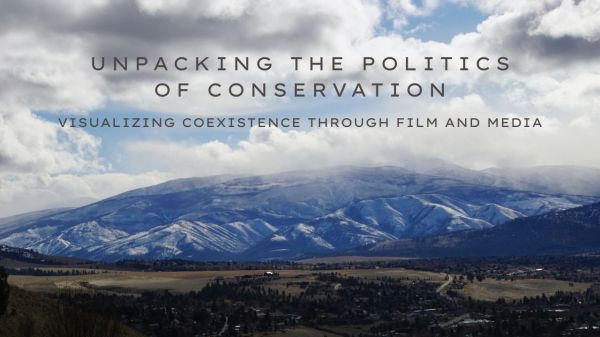
The documentary I've created, Unpacking the Politics of Conservation, explores the intersection of politics and conservation, alongside the ramifications of their integration, particularly as it relates to the issue of human-predator conflict. The final product is the culmination of months of hard work, weeks spent navigating logistics and technical setbacks, rigorous challenges, substantial trial and error, and multiple stages of revision. Despite a lengthy and arduous process, I was motivated by the wisdom, generosity, cooperation, and patience of upstanding individuals who supported me throughout my journey.
For more information on my project or further details about my creative process...
Land Acknowledgment
The 吃瓜网 acknowledges we are in the aboriginal territories of the Seli’š and Qlispe’ people. We honor the path they have always shown us in caring for this place for the generations to come. For many generations, the Salish, Kootenai, Pend d'Oreille, and other tribes, including the Blackfeet, Nez Perce, Shoshone, Bannock, and Coeur D'Alene, have shaped and influenced the landscape, purpose, and impact of education in the Missoula Valley.
Background Context
In early America, fears of wolves and wilderness were widespread and fervent. Nonetheless, these considerations were grounded and legitimate. Folk tales and cultural narratives like “The Big Bad Wolf” conjured frightening imagery and branded wolves as fearsome adversaries - as competition for resources, hazards to livestock, and enemies to the colonial projects of expansion and frontierism. But despite humanity’s best efforts to eliminate wolves from the continental United States, their story has yet to end - a testament to their unrivaled determination and tenacity.
In ways mirroring narratives like “The Big Bad Wolf,” political polarisation tends to provoke individuals, causing them to project malice or ill intentions onto their opponent. This manifests in a dissolution of avenues for genuine conservation and positive collaboration, resulting in a culture of intolerance and division. Reflecting the broader political atmosphere, ideological polarization has infiltrated discussions about environmental conservation. Both conservation attitudes and political viewpoints tend to one side of two extremes, pitting factions against one another, leaving the center position vacant, and allowing little room for nuance or compromise. Understandably, this has led to a tense and rigid political climate, but it has also inspired the proposal of constructive and innovative solutions to the problems polarisation poses.
Given these insights, I wondered how much of the way we view human-predator conflict is the product of real, sensible concern or mistrust, and how much of it can be attributed to fear of or disdain for “The Big Bad Wolf?” Similarly, what considerations motivate conservation attitudes, and what really drives the vehement tension we witness in conservation and in politics? Are there better ways for us to manage human-predator conflict, and if so, what might that say about our ability to relate to or live together with wolves? How might coexistence strategies used to mitigate human-predator conflict translate to alleviate political polarisation, and moreover, what might these approaches reveal about our interpersonal engagements and understandings of one another?
Visualizing Coexistence Through Film and Media
In generating ideas and researching options for this project, I was driven by a desire to explore in-group and out-group behaviors, a curiosity surrounding the dynamics and attitudes present in rural, Western communities, and an urge to deeply analyze conventional dichotomies, such as the urban-rural divide or the East-West contrast. I also wanted to integrate environmental philosophy with some of my more neglected interests: political analysis, filmmaking, and visual media.
Because personal experience and testimony deeply intrigue me and play a formidable role in practical problem-solving, I found it imperative to call upon the practical knowledge, expertise, and assistance of two well-versed individuals: Jeremy Sunderaj, a University alum and biologist for the Yellowstone Wolf, Cougar, and Elk Project, and Malou Ramirez-Anderson, a multi-generational rancher, founder of the Tom Miner Basin Association, and CEO of Teal Enterprises, both of whom have extensive and intimate experience with predator conflict.
Through directed interviews, aesthetic choices, and narrative storytelling, the resulting documentary aims to contribute to a more comprehensive explanation of the issue through a synthesis of perspectives and an analysis of interests, inviting 吃瓜网ns of both compatible and contrasting viewpoints to the table to help one another see or think about human-predator conflict in other ways.
Theoretical Influences
-
Although the influence of social identities on political polarisation is documented and well-established, the ways in which political identity activation may affect attitudes surrounding conservation initiatives have not garnered significant attention. This article, published by 吃瓜网 professors Dr. Alex Metcalf and Dr. Justin Angle, analyzes the dynamics of identity and how these factors may influence peoples’ viewpoints on conservation initiatives. Using participants’ attitudes on wolves in tandem with their expressed political affiliations, Metcalf and Angle demonstrate how activating social identities may contribute to interpersonal misunderstandings or misconceptions, causing those involved to over- or underestimate both their opponents’ viewpoints and their own stances, and further distancing contrasting positions. Concerning the future of conservation initiatives, this article offers potent insights into how we perceive the attitudes of our ideological rivals and how we perceive our own attitudes, in addition to providing innovative paths forward despite strong division.
-
One strategy used in human-predator conflict mitigation is range riding, which employs a human presence on the landscape to prevent depredation and ensure livestock safety. This article examines the implementation of range riding strategies, critically evaluates their efficacy, and explores the benefits, drawbacks, and implications of adopting range riding practices.
Theoretical Applications
-
In The Incarceration of Wildness (1990), philosopher Thomas Birch details an account of wilderness under “the imperium,” a commanding authority that works to systematically dominate and eliminate defiance to its unrestricted power and rigid social order. Although the imperium functions covertly to advance the project of domination, remarkably, it does not seek to annihilate the “Other” altogether. Not only does wilderness resist the imperium’s authority without regard for its prescriptive, artificial bounds or limitations, but it further complicates the imperial project of domination. For the imperium to completely destroy such an “Other” would be a clear exhibition of its unbridled power. Instead, the imperium conceals its capabilities, working to constrict and confine wilderness and, in turn, wildness, to places it cannot interfere with the execution of strict order and control. Confinement is accomplished through systemic categorization, definition, restriction, separation, or absorption, perhaps better understood as “bringing the law” to the “Other.” (Birch, 7)
In its attempt to bring the “outlaw” under its control, the imperium absorbs wilderness, or non-human nature more broadly, into a hierarchical structure under which it is “granted” rights it already seems to possess. Importantly, though, the imperium refuses to grant categorized “Others” full self-governance or autonomy. The chief purpose of the imperium is control, in particular, control over designated “Others,” or “otherness” more broadly. (Birch, 18) In its struggle to coordinate uniform conformity, the imperium obstructs any attempt to escape its authority. In essence, the imperium seeks not just to set apart or isolate wilderness, but to eliminate any possibility of a life apart from or outside of it. While this testifies to the formidable resilience of wilderness, it also speaks to the ability of the imperium to bring humanity under its control. Under Birch’s framework, the inherent connections between humans and the natural world they inhabit become exponentially clearer, as both subjects are subjugated by the same forces, for the same reasons.
Looking towards human-predator conflict and the principles of coexistence may suggest other escapes from the imperium. When we restrict wolves, we attempt to civilize them or bring them under our control. Despite this, wolves adapt to our human structures in a display of wild resistance. Drawing on this point, it seems that wolves serve as a strong role model for navigating the Anthropocene, demonstrating how to endure the challenges of an increasingly manufactured world. The fate of humanity and the fate of non-human nature are intertwined in the Anthropocene. Dominated by the same ruthless forces, what becomes of nature will become of us.
-
In Reasoning: A Social Picture (2012), philosopher Anthony Laden presents a powerful, dynamic account of reasoning that stands in contrast to the standard picture society often operates upon. Rather than conforming to a picture of reasoning premised on logic and domination, Laden suggests reasoning is a social activity that prioritizes “proposing, engaging, conversing, and… mutual attunement” over “calculating, deducing, problem-solving, and judging,” requiring a sense of shared responsivity and reciprocity. (Laden, 8) Under this view, social reasoning is reflective of the democratic process - it is a form of joint decision-making that is both ongoing and norm-governed. These two components of reasoning foster the construction of non-hierarchical relationships, in which one’s goal is not persuasion but mutual understanding. (Laden, 31) In this respect, Laden’s account of social reasoning may offer relevant and pertinent wisdom for navigating human-predator conflict, or similarly, stand as a potential remedy to contemporary political polarization.
Laden’s illustration of engaged reasoning presents a potent alternative to the standard picture, demonstrating how to effectively reason with one another, rather than past one another. Aside from providing useful guidelines as to how to engage in more productive and beneficial ways, social reasoning may also help us to “live together” more responsibly. (Laden, 265) In this respect, social reasoning can be thought of as a means of coexistence - a mutual adaptation in which both sides make concessions in such a way that they speak for a larger “we.” When engaging on the topic of human-predator conflict, we may fail to reason in a multitude of ways - when we refuse to acknowledge our opponent’s considerations, when our reasons fail to sincerely speak for us, when we isolate ourselves from disparate viewpoints, or when we fall back onto the standard picture of dominative reasoning. All things considered, social reasoning is by no means an easy process. In light of the influence of political ideology on conservation objectives, social reasoning provides valuable prescriptions as a potential solution, and further reminds us that the most demanding and difficult conversations are the ones most worth having.
-
In the second chapter of Thinking like a Mall (2015), author and philosopher Steven Vogel relays the social construction of nature, breaking down the common human-nature dualism embedded in conceptions of wilderness. Though wilderness is typically framed as an escape from modern society, Vogel argues that such constructions cannot be alienated from their historical and social contexts, and accordingly, that interventions like wilderness are constructed in the context of human social practices. (Vogel, 38) Vogel further dismantles the human-nature distinction, presenting a view under which human actions are indistinguishable from “natural” processes. With this understanding, the idea of wilderness as “untrammeled” or “untouched” becomes far less sensible, and human practices begin to appear as natural forces. While his account spells trouble for “early generation” ideas of wilderness, it conversely provides space for us to more deeply analyze the structures we build and how we can create institutions with more intention and deliberation for the benefit of the environment’s human and non-human inhabitants.
Coexistence is dependent on ecological carrying capacities, but perhaps more importantly, it hinges on human tolerance. Despite the troubles caused by the Anthropocene, there are ways in which Vogel’s account of the social construction of nature can connect to the contributions provided by coexistence strategies. If human action is paramount in the Anthropocene, and we can make the environment, or our world more broadly, what we want it to be, then it seems the construction of more effective strategies of coexistence, or a better world more broadly, is possible.
Acknowledgments
The support, encouragement, and mentorship I received throughout the engagement process profoundly shaped my work and made completing this project possible.
First, I would like to express my utmost gratitude to my family and friends on the East Coast for their constant love and unwavering faith in me - I would not be where I am today without them.
I extend a special thank you to Lisa Upson of People and Carnivores and Patrick Kelly of the Western Watersheds Project for their wise counsel and remarkable generosity in the early stages of this documentary. Your vast knowledge and invaluable experience strengthened my understanding and provided me with the grounding required to engage on this topic with prudence, intention, and care.
Likewise, I owe my deepest appreciation and a very sincere thanks to Jeremy Sunderaj of the Yellowstone Wolf, Cougar, and Elk Project and Malou Anderson-Ramirez of the Tom Miner Basin Association for their expert insights, transparent communication, and willingness to aid and participate in this project. I hold a deep admiration for the work you both have undertaken, and I am honored by your eagerness to share your honest and intimate perspectives with me - your viewpoints were truly essential and indispensable to this documentary.
Furthermore, I am immensely grateful for the kindness, integrity, and constructive assistance of 吃瓜网 professor Dr. Alexander Metcalf, whose recent research with Dr. Justin Angle greatly informed this project’s approach, and whose contributions inspired much of this documentary’s development and direction.
I would also like to express my heartfelt gratitude to Dr. Soazig Le Bihan and Dr. Christopher Preston for their unparalleled leadership, passionate dedication, and exceptional patience. Your investment in your students and your genuine care for their personal and intellectual development do not go unnoticed. Similarly, I owe a special thanks to Dr. Jeffrey Stephenson and to Dr. Charles Hayes for their practical advice, positive feedback, and for their trust in me and my capabilities.
Above all, I extend my most sincere thanks and recognition to my advisor, Dr. Matthew Strohl, for his thoughtful guidance, wisdom, and motivation throughout this process, and throughout my time here at the University. This project could not have been accomplished without the support of my cohort, Casey, Cecilia, Shane, and my fellow students in the Environmental Philosophy graduate program. I am eternally grateful for our conversations and for the opportunity to be a part of such an incredible intellectual community.